The Highland blog
Do Gutter Guards Work? What They Solve and What They Do Not
By Highland Roofing3 min read
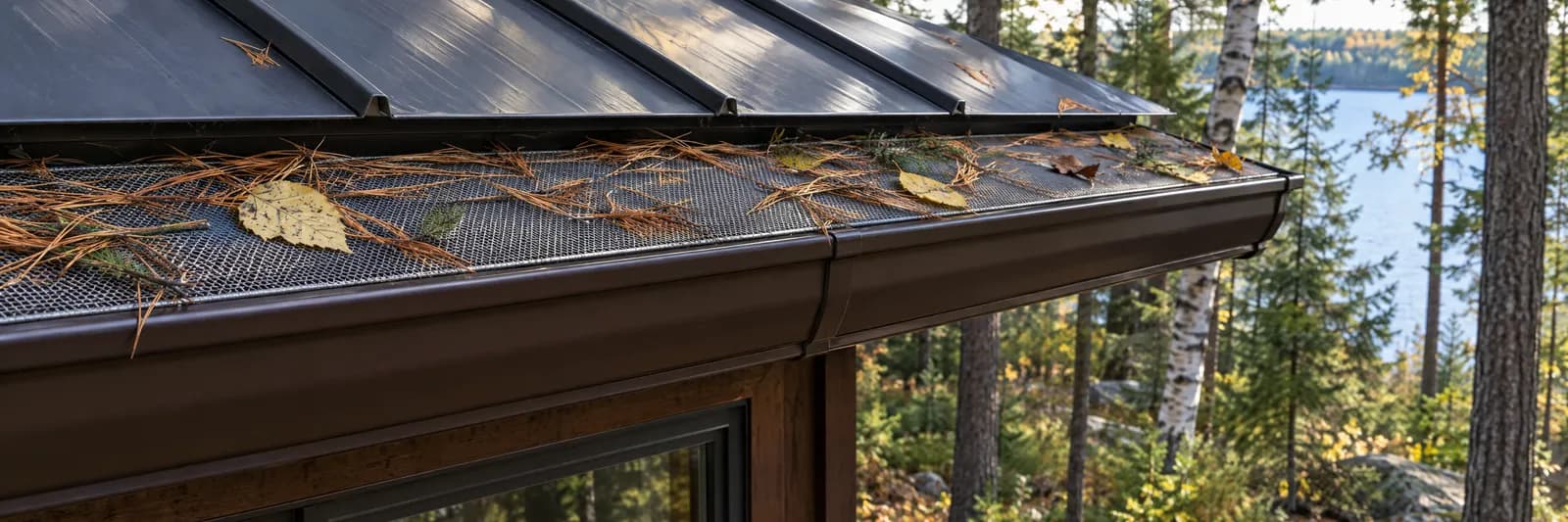
Gutter guards are sold on the promise that you will never clean an eavestrough again. That promise is the problem. Good guards, matched to your trees and installed properly, reduce how often troughs need attention, sometimes by a lot. No guard ends it.
Go in expecting less maintenance rather than none, and guards are often worth having.
What they actually do
A guard covers the top of the eavestrough so that leaves and larger debris stay out while water still gets in. Debris that stays on top either dries and blows away or sits there until someone brushes it off. Either is easier than scooping wet sludge out of a trough.
The useful question is which debris your trees produce, because each type of guard handles different debris well.
The main types
- Screens. A coarse grid over the trough. Cheap and good at stopping big leaves, but needles, seeds and maple keys go straight through or lodge in the openings.
- Fine mesh. A tight stainless or aluminium mesh, usually on a rigid frame. Stops most needles and small debris. Fine debris can mat on top and needs brushing off from time to time.
- Reverse-curve or surface-tension covers. A solid cover with a rounded front edge. Water follows the curve into the trough and leaves slide off. Effective with big leaves. In very heavy rain water can overshoot, and the narrow opening can collect needles.
- Inserts. Foam or brush that sits inside the trough. Easy to fit, but they trap fine debris themselves and need to be taken out and cleaned.
As a rough guide: big deciduous trees suit most types; pines and spruce generally need fine mesh.
Where guards fall short
- Fine debris still gets in. Roof grit, pollen and seeds pass through most guards and settle in the trough over time.
- Debris sits on top. On low-slope or sheltered runs, wet leaves can stay put on the guard and block water from getting in.
- Winter. Snow and ice form on guards just as they do on open troughs. Guards do not prevent ice dams; ice dams explains where those really come from.
- They hide problems. With a cover on, you cannot see a sagging section or a blocked outlet until it overflows.
Guards on a metal roof
Many guards are designed to slide under the bottom row of shingles. That does not work on a metal roof. A guard fastened through the panels makes holes the roof was never meant to have, and one wedged under the panel edge can interfere with the drip edge that throws water into the trough.
On a metal roof, the guard should attach to the eavestrough or the fascia and leave the roof alone. Ask how any guard will be fixed before it goes on.
Are they worth it?
They usually are if your house is under trees, if the roofline is high or awkward to reach, or if it is a cottage nobody will be at when the leaves come down. They are less worthwhile on an open lot with few trees, where a yearly clean takes half an hour.
Either way, guards are only as good as the eavestrough underneath. Fitting them to troughs that already sag or leak just covers up the problem. Cleaning eavestroughs covers what to check first.
Highland installs gutter guards, on their own or with new eavestroughs. Tell us about your trees and we will suggest what suits them.